Three weeks ago I sat down to finish a piece for my portfolio, opened a blank canvas in Procreate, and just… stared at it. Forty minutes later I’d renamed three layers, reorganized my brush folder, and drawn exactly nothing. That’s art block, and if you’ve ever sat in front of a blank page feeling like you forgot how to make anything good, you already know exactly how it feels.
What actually got me moving again wasn’t inspiration or some burst of motivation. It was a stupid-simple list of art prompts I’d saved in my Notes app almost a year earlier. I picked one at random — “draw your morning routine as a video game loading screen” — set a 20-minute timer, and just followed it instead of trying to invent something “good” out of thin air. That one sketch turned into four more that week.
Since then I’ve built a working system around art prompts: the ones I actually reach for, the tools I use when my list runs dry, and a formula for writing AI art prompts that stopped my Midjourney results from looking like generic stock art. This guide is that whole system in one place, plus a list of 100+ art prompts sorted by skill level so you can start using them today.
What Are Art Prompts?
An art prompt is just a short nudge that tells you what to make — a subject, a scene, a weird combination of two ideas — so you’re reacting to something instead of inventing from a completely blank slate. That’s really it. No mystical creativity required. A prompt like “a lighthouse keeper who’s afraid of the dark” gives your brain a specific problem to solve instead of an infinite empty page to fill, and solving a specific problem is so much easier than staring down infinite possibility.
I think of art prompts as training wheels for imagination. You won’t need them forever, but on the days your brain refuses to generate its own ideas, they get you moving again.
Traditional Art Prompts vs. AI Art Prompts
The word “prompt” means two slightly different things depending on where you’re using it, and it trips people up constantly.
Traditional art prompts are short, open-ended ideas that you interpret yourself with a pencil, brush, or stylus. Something like “an underwater market” or “your pet as a knight.” You decide the composition, the colors, the style — everything. The prompt just hands you a starting point and gets out of the way.
AI art prompts are full text descriptions you feed into a tool like Midjourney, Stable Diffusion, or GPT Image so the software generates the image for you. These need a lot more detail — subject, art style, lighting, color palette, camera angle — because the AI can’t read your mind the way you can read your own. A traditional prompt might be four words. A solid AI art prompt is usually a full sentence or two.
Both do the same job: they kill the blank-page problem. They just hand off the “who’s doing the interpreting” part differently. I use both depending on whether I want to actually practice drawing or just want to see an idea visualized fast.
Why Every Artist Needs Art Prompts
They break creative block when nothing else does
Art block isn’t usually a lack of ideas. For me it’s almost always the opposite — too many half-formed ideas and a weird fear that whatever I pick will be the “wrong” one. A prompt removes the choosing. You’re not deciding what’s worth making anymore, you’re just executing. I’ve genuinely never sat down with a specific art prompt in front of me and had the same frozen, staring-at-nothing feeling I get from a truly blank page.
They build the daily habit that actually improves your art
Every artist I know who’s improved fast did one boring thing: they drew constantly, not just when they felt like it. Art prompts make that sustainable because you never run out of “what do I even draw today.” I went through a stretch of using one drawing prompt every morning before work, just 15–20 minutes with coffee, and after about two months my linework was noticeably faster and more confident. Not because the prompts were magic, but because I was drawing five more days a week than I used to.
One caveat from actually living through this: turning prompts into a rigid daily obligation can backfire. I tried a strict “365 days, zero exceptions” streak once and burned out by day 40 — missed one day, felt like a failure, and quit the whole habit entirely. Now I aim for “most days” instead of “every single day,” and it’s actually stuck for over a year.
They push you into skills you’d never choose on your own
Left to my own devices, I draw the same three things forever: portraits, moody lighting, and cats. Art prompts that specify an unfamiliar subject, medium, or angle force practice I’d otherwise dodge. “Draw a crowded scene from directly above” isn’t a prompt I’d ever assign myself, but it’s exactly the kind of thing that fixes a weak spot — in my case, perspective and composition with a lot of figures in one frame.
Types of Art Prompts (With Examples)
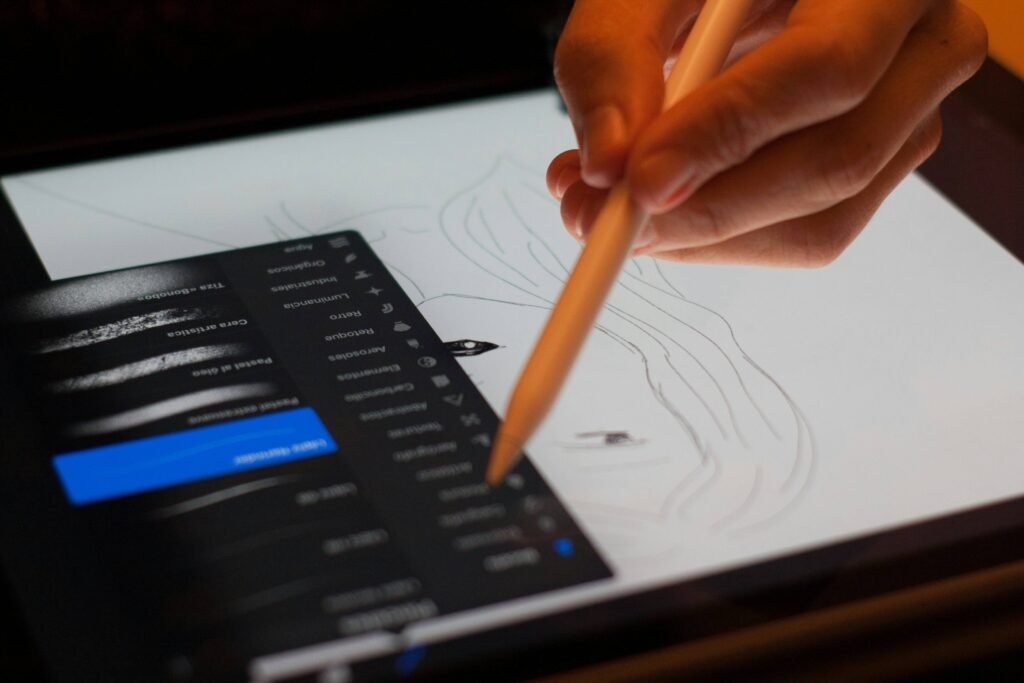
Drawing Prompts
These work great for pencil, ink, or a quick digital sketch — low pressure, fast to finish, perfect for warming up.
- A creature that only comes out during thunderstorms
- Your shoes, but they’ve been enchanted
- Someone waiting for a bus that’s never coming
- A staircase that leads somewhere it shouldn’t
- Your hand holding something that doesn’t exist yet
- A tree growing straight through the middle of a building
- Two strangers sharing one umbrella
- A monster having a completely ordinary Tuesday
- The view from inside a fishbowl looking out
- A door that’s way too small for the room it’s in
- Your reflection, except it’s having a much better day than you
- A market stall selling something impossible
Painting Prompts
Whether you’re working in watercolor, acrylic, oils, or digital brushes, these lean into color, light, and atmosphere.
- A sunset over a place that doesn’t exist
- The inside of a seashell reimagined as a landscape
- A storm rolling in over completely calm water
- A single flower growing out of a crack in concrete
- A city skyline reflected in a rain puddle
- Fire and water meeting in the same scene
- An abandoned greenhouse being reclaimed by plants
- A festival lit entirely by paper lanterns
- The last light of the day hitting a mountain range
- A room seen through fogged-up glass
- Autumn leaves caught mid-fall
- A quiet harbor at dawn before anyone’s awake
Character Design Prompts
Good for building a portfolio piece, practicing silhouettes, or just having fun with personality and backstory.
- A retired supervillain who now owns a bakery
- A bounty hunter who’s secretly terrified of the dark
- A librarian who moonlights as a smuggler
- A knight whose armor is made of glass
- A street vendor working in a floating city
- A weather-controlling hermit who lives alone in a tower
- A robot raised by animals instead of humans
- A pirate captain who gets seasick every single voyage
- A gardener who can talk to the plants she grows
- A messenger who delivers letters between dimensions
- An assassin who’s secretly a terrible cook
- A young witch who inherited her grandmother’s grumpy cat familiar
AI Art Prompts
These are written to be pasted straight into an AI image generator. Notice they’re longer and way more specific than the traditional prompts above — that detail is what separates a usable AI art prompt from one that returns something totally random.
- A lone astronaut sitting on the edge of the moon watching Earth rise, digital painting, soft blue and orange lighting, melancholic mood, wide cinematic composition
- An elderly clockmaker’s workshop filled with floating gears, warm candlelight, oil painting style, cluttered and cozy composition, muted gold and brown palette
- A cyberpunk street food vendor at night, neon signage reflected in rain puddles, digital illustration, vibrant magenta and teal lighting, close-up composition
- A treehouse village connected by rope bridges at golden hour, watercolor style, warm amber light, wide-angle establishing shot, peaceful mood
- A samurai standing in a field of cherry blossoms during a storm, dramatic lighting, ink wash painting style, high contrast, dynamic low-angle composition
- An underwater library with fish swimming between the bookshelves, soft caustic lighting, fantasy digital art, teal and cyan color palette, dreamlike mood
- A cozy witch’s cottage kitchen with potions bubbling on the stove, warm firelight, cottagecore illustration style, close composition, inviting mood
- A desert caravan crossing dunes under a sky with two moons, sci-fi matte painting, cool purple and orange gradient sky, epic wide shot
- A steampunk inventor’s cluttered workshop, brass and copper machinery, dramatic side lighting, detailed digital painting, warm sepia tones
- A quiet mountain shrine covered in fresh snow at dusk, minimalist composition, soft blue twilight lighting, traditional ink painting style, serene mood
- A giant turtle carrying a small floating city on its back, fantasy concept art, golden hour lighting, epic wide composition, vibrant color palette
- A vintage train speeding through a valley at night under a full sky of stars, retro travel poster style, bold flat colors, warm nostalgic mood, dynamic diagonal composition
How to Write Better Art Prompts (Step-by-Step Guide)
This formula is built mainly for AI art prompts, since that’s where extra detail actually changes your result. But I use a lighter version of it for traditional pieces too, whenever I want more direction than a one-line prompt gives me.
The formula: Subject + Style + Medium + Lighting + Color + Mood + Composition
Here’s how I actually build one, step by step:
- Start with the Subject. Be specific. Not “a warrior,” but “a one-armed warrior resting after a battle.” The more concrete the subject, the less the AI has to guess.
- Add the Style. This is your art movement or aesthetic reference — anime, ukiyo-e, cyberpunk illustration, art nouveau, oil painting.
- Choose the Medium. Digital painting, pencil sketch, 3D render, photograph. This overlaps a bit with style, but it tells the tool what material or technique the final image should look made with.
- Set the Lighting. Golden hour, harsh noon sun, candlelight, neon glow, backlit silhouette. Lighting does more heavy lifting for mood than people expect.
- Pick a Color Palette. Two or three dominant colors is plenty. Warm versus cool, muted versus saturated.
- Define the Mood. Melancholic, whimsical, tense, peaceful, chaotic — one or two words is enough.
- Decide the Composition. Wide shot, close-up, bird’s-eye view, symmetrical, rule of thirds.
Before and After: A Real Example
Weak prompt: “a dragon in a forest”
Same idea, run through the formula: “An old forest dragon covered in moss, curled protectively around a crumbling stone ruin, fantasy digital painting, dappled sunlight filtering through the canopy, deep green and gold color palette, ancient and peaceful mood, wide low-angle composition.”
Same basic idea. Completely different, far more usable result.
Mistakes I Made (So You Don’t Have To)
- Stacking contradictory descriptors. I once wrote a prompt asking for “vibrant AND muted, chaotic AND serene” in the same breath. The AI doesn’t pick one — it just averages both into a muddy mess. Pick one direction per attribute.
- Skipping style and medium entirely. Leave those out and you get the same generic, slightly plastic “AI look” no matter what the subject is.
- Being too vague on the subject. “A fantasy scene” can return literally anything. The subject line is not where you save your effort.
- Treating the first result as final. My first generation is almost always a rough draft. I usually tweak one or two words — swap the lighting, adjust the mood — and regenerate two or three times before I land on something worth keeping.
- Over-formulizing traditional prompts. For a quick warm-up sketch, cramming in style, lighting, color, and mood defeats the purpose. Traditional prompts work better short — let your own instincts fill in the rest.
Best Art Prompt Generators & Tools
When my own list runs dry, these are the tools I actually open. I’ve mixed AI-focused and traditional ones here since most artists I know use both.
| Tool | Best For | Free Access | Traditional or AI |
|---|---|---|---|
| Lexica.art | Searching real AI art prompts and generating images | Free to browse; limited free generations | AI |
| PromptHero | Huge searchable library, filterable by model (Midjourney, Stable Diffusion, DALL-E) | Free to browse and search | AI |
| Random drawing prompt sites | One-click traditional sketch ideas, no signup | Fully free | Traditional |
| r/SketchDaily & art Discord servers | Daily community prompts plus built-in accountability | Free | Traditional |
| ChatGPT / Claude | Brainstorming custom prompts around a specific mood or theme | Free tier available | Both |
Lexica.art is my go-to when I want to see what a prompt actually produces before I commit to it myself. You search a concept, browse existing AI-generated images, and copy the exact art prompt that made each one. I’ve reverse-engineered probably a hundred prompts this way — tweaking one color word or style reference and rerunning it in Midjourney instead.
PromptHero has an even bigger library, and you can filter by which model a prompt was built for, which matters more than people expect. A prompt written for Midjourney doesn’t always translate cleanly to Stable Diffusion or GPT Image. I lean on it mostly when I’m stuck on how to phrase a specific look — like trying to describe a very particular anime art style in words that actually work.
Random drawing prompt generators are for actual pencil-and-paper practice, and I don’t overthink these. A site that spits out one traditional prompt with a single click is perfect for a 10-minute warm-up, because you’re not evaluating options — just reacting to whatever you got.
r/SketchDaily and art Discord servers are the free tool nobody talks about enough. Most post a prompt daily and have a whole thread of people sharing their attempts, which gives you the prompt and instant accountability in one place. I stuck with a daily sketch habit far longer through a Discord server than I ever did pulling from my own private list.
ChatGPT or Claude come in when none of the above hits the right vibe. I’ll describe what I’m actually in the mood to draw — “something moody, autumn, no people” — and ask for five prompt variations. It’s the fastest way to get a custom art prompt built around a feeling instead of scrolling someone else’s list hoping something clicks.
100+ Art Prompts List (Ready to Use)
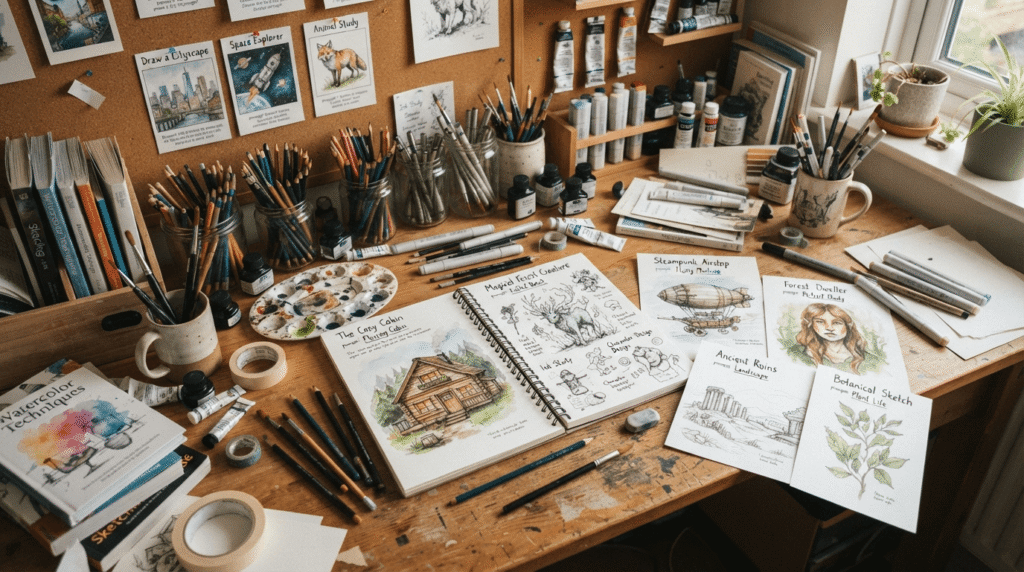
Pick one, set a timer, and just start. Don’t overthink which one is “best” — that’s the whole point.
Beginner Art Prompts
- Your favorite mug from an angle you’ve never drawn it from
- A houseplant that’s clearly been through a lot
- Your dominant hand, relaxed and open
- A pair of worn-out sneakers
- An open book with the wind turning the pages
- A cat asleep in a sunbeam
- Your keys sitting next to your wallet on a table
- A candle that’s almost burned all the way down
- A single cloud shaped like something else
- A half-eaten sandwich
- Your bedroom window at night
- A backpack after a long trip
- An umbrella left open to dry
- A cup of coffee going cold
- Your pet (real or imagined) mid-yawn
- A pair of glasses folded on a desk
- A bowl of fruit where one piece is fake
- A doorknob with the key still in it
- A pair of hands tying a shoelace
- A potted succulent on a windowsill
- A single sock that lost its match
- A crumpled piece of paper
- Your own silhouette against a doorway
- A teapot mid-pour
- A stack of books you haven’t read yet
- A rainy window with a blurred street outside
- A pencil sharpener full of shavings
- A jar of loose buttons or coins
- A folded umbrella leaning by a door
- A slice of cake with one bite missing
- A pair of headphones tangled on a desk
- A houseplant reaching toward a window
- A worn-out welcome mat
- A single shoe left by the front door
- Your reflection in the back of a spoon
Intermediate Art Prompts
- Two people waiting at a bus stop in the rain, not talking
- A street performer mid-act with a small crowd watching
- A kitchen mid-dinner-prep, chaos and warmth at once
- A campsite at dusk, the fire just catching
- A crowded night market seen from one stall’s point of view
- A subway car at rush hour with exactly one empty seat
- A treehouse being built, tools scattered everywhere
- A greenhouse where plants are overtaking the walkway
- A used bookstore with a cat asleep on the counter
- A rooftop garden at sunset overlooking a city
- Someone packing a suitcase in a hurry
- A repair shop full of half-fixed machines
- A classroom right after everyone’s left for the day
- A fishing boat coming into harbor at dawn
- A tailor’s workshop mid-project, fabric everywhere
- A carnival ride frozen mid-spin
- A porch during a thunderstorm, someone watching from inside
- A record store with someone flipping through vinyl
- A bakery just before opening, trays coming out of the oven
- A train platform where two people are saying goodbye
- A tattoo studio, the artist completely focused mid-session
- A garden overtaken by weeds with one flower still blooming
- A diner at 2am, one customer, one waitress
- A workshop where someone’s restoring an old bicycle
- A crowded elevator where everyone’s on their phone except one person
- A mountain trail with a storm rolling in from one side
- A pet store window at night, animals watching the street
- A laundromat with one person folding clothes alone
- A farmers market stall mid-setup before customers arrive
- A music shop with instruments hanging on every wall
- A hallway lined with closed doors, one slightly open
- A skate park at golden hour, one skater mid-trick
- A greenhouse nursery with someone watering rows of seedlings
- A ferry crossing choppy water at sunset
- A tailor fitting a wedding dress, pins still in the hem
Advanced Art Prompts
- A battle’s aftermath seen from above, one survivor searching the wreckage
- A city built into the side of a cliff, connected by hundreds of stairs
- A royal court frozen mid-scandal, every expression different
- An underwater city glimpsed through a submarine window
- A festival crowd seen from a rooftop, hundreds of tiny figures below
- A duel between two mismatched fighters in a collapsing building
- A caravan crossing a canyon bridge in a sandstorm
- A council of creatures from different worlds negotiating peace
- A marketplace riot breaking out, chaos radiating from one point
- A multi-generational family portrait spanning three different eras
- A shipwreck being explored by divers, light shafts cutting through the water
- A coronation scene lit dramatically from directly above
- A war camp at night, dozens of small fires scattered across a valley
- A crumbling cathedral reclaimed by nature, light through broken stained glass
- A chase scene through a crowded street market, motion implied throughout
- A council chamber where every seat holds a different species
- A city skyline mid-transformation between day and night
- A battlefield medic treating the wounded under fire
- A migration of a hundred creatures crossing a vast plain
- A masquerade ball where exactly one guest isn’t wearing a mask
- A shipyard where a massive vessel is being built plank by plank
- A crowd scene where all the tension sits in one sympathetic face
- A multi-level dungeon cutaway showing several rooms at once
- A negotiation table where the tension is entirely in the body language
- A stampede of animals fleeing a wildfire in the distance
- A palace under siege, defenders on the walls, attackers below
- An orchestra mid-performance, the conductor caught in a dramatic pose
- A crumbling space station with astronauts racing against the clock
- A tournament arena at the exact moment of a decisive hit
- A crowded refugee camp at dusk, cooking fires and makeshift tents
- A cathedral ceiling fresco viewed from directly below
- A trading caravan setting up camp as a storm closes in from two directions
- A grand library with impossible architecture, stairs leading in every direction
- A duel between two mages, spell effects lighting the entire scene
- A city flooding in real time, residents evacuating by boat
Frequently Asked Questions
How do I write AI art prompts?
Use the formula from earlier in this guide: Subject + Style + Medium + Lighting + Color + Mood + Composition. Start with a specific subject, then layer in the rest one piece at a time. You don’t need all seven elements every time, but the more of them you include, the less the AI has to guess — and guessing is where weird, off-target results come from.
What are good art prompts for beginners?
Simple, single-subject prompts with low stakes attached. Think an everyday object from an unusual angle, or a pet mid-action, rather than a sprawling scene with ten elements. The goal early on is finishing something quickly and building momentum, not producing a masterpiece. The beginner list above is exactly this kind of prompt — small, specific, and done in 15–20 minutes.
How do I make good AI art prompts?
Writing the first version is only half the job — the real skill is in refining it. A few things that consistently improve my results:
- Regenerate two or three times before judging a prompt as “bad.” Small variance is normal.
- Keep a prompt for one model at a time. What works beautifully in Midjourney often needs rewording for Stable Diffusion or GPT Image.
- If something keeps showing up that you don’t want, say so directly rather than just removing it from the prompt — many tools support negative prompts specifically for this.
- Change one variable at a time when troubleshooting (just the lighting, just the color), so you actually know what caused the shift.
Where can I find random art prompts?
Lexica.art and PromptHero are solid for AI-specific prompts with real examples attached. For traditional sketching, a random drawing prompt generator or a community like r/SketchDaily works well since new prompts show up daily without any effort on your end. My favorite low-tech trick, though: look around the room, pick two unrelated objects, and combine them into one prompt. “Umbrella” and “spaceship” becomes “an umbrella that doubles as an escape pod.” It works more often than it has any right to.
One More Thing
Honestly, the biggest shift for me wasn’t finding the “perfect” prompt — it was picking one and starting before I could talk myself out of it. My sketchbook right now is basically a graveyard of random art prompts from lists just like this one, half-finished and messy, and that’s kind of the point.
Pick one from above, set a timer for 20 minutes, and see what happens. Worst case, you’ve spent 20 minutes drawing instead of scrolling. Best case, you’ve broken whatever block had you stuck in the first place.
If you end up using one of these, I’d genuinely love to see what you made with it.
Ready to Show Off Your Art? Once these art prompts help you build a solid collection of sketches or digital pieces, you’ll need a proper place to display them. If you’re putting together a portfolio for clients or college, check out my step-by-step guide on [how to build a professional resume website for free using AI]—it’s the easiest way to get your artwork online and looking professional in under an hour.